
~From Roots to Shoots~
The Mighty Oaks Are Under Attack
For several decades the oak species has been under attack due to bacterial leaf scorch. BLS is a bacterium that spreads by feeding insects. Once the bacterium colonizes an oak tree, a chronic decline of the tree is underway. This takes many years but ultimately kills the tree. BLS has been a serious threat to red, black, and pin oak species.
A second potentially threatening pathogen, Ceratocystis fagacearum, is a fungal disease known as oak wilt. To date oak wilt has held to west of the Susquehanna River, but may be moving east. It appears to be not if, but when oak wilt will arrive.
Oak wilt attacks most oaks, but especially those in the red oak group. White and bur oaks are less susceptible than red oaks. Susceptible trees can die within a few weeks while those with some resistance may decline slowly for 2 - 3 years. Even if a diagnosis isn’t confirmed, your trees could still be in danger.
Symptoms of Oak Wilt
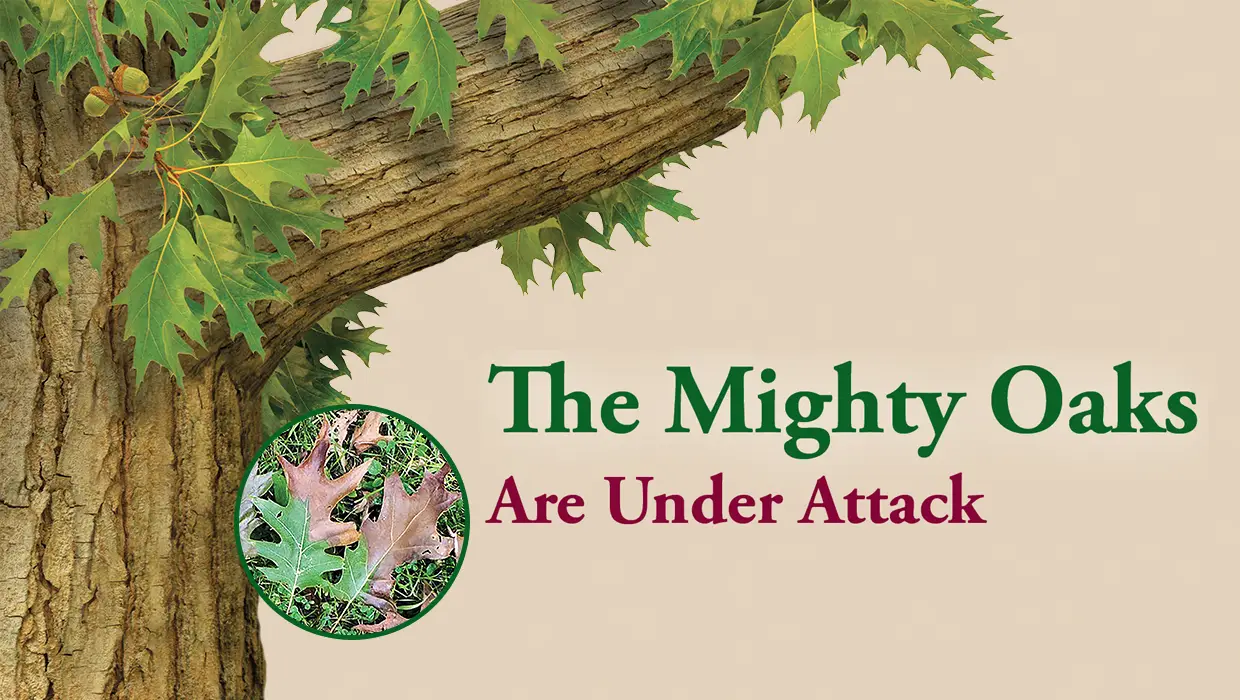
Leaves at the top of the tree will turn brown along the edges and wilt, eventually falling while there is still some green color left. The fungus will continue to progress in the tree. When the ends of the twigs are cut, the outermost annual ring may be completely brown. A fungal mat develops under the bark, accelerating in the spring.
Spread
- Sap-feeding and bark beetles feed on the fungal mat that erupts through the bark in the Spring and pick up sticky spores. They spread the spores as they move short distances to adjacent oaks to feed on fresh, bleeding wounds. A fresh wound is required by the fungus in order to invade.
- Transport of infected logs is one way the fungus can be moved long distances.
Management
- Obtain a positive diagnosis that oak wilt is the cause of the wilting and defoliation.
- Break root grafts to nearby oaks before removing an infected tree.
- Prune only during November through mid-April.
- Trees not yet infected can be protected by injecting a fungicide once every 2 years.