Bacterial Leaf Scorch
Xylella fastidiosa
Description
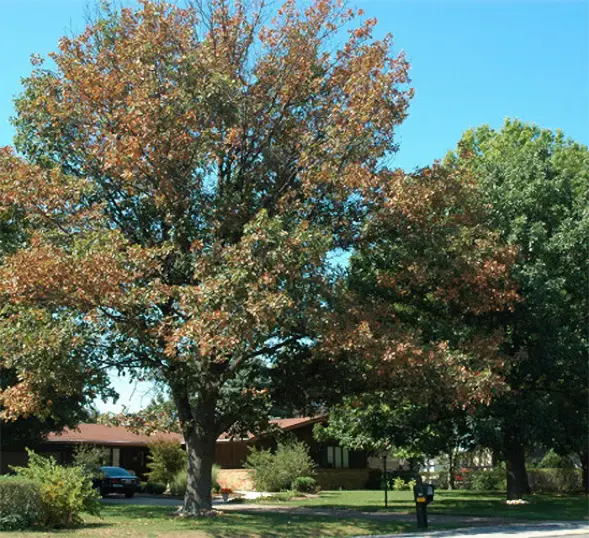
Bacterial Leaf Scorch is an important and often fatal disease of landscape trees. The causal bacterium colonizes the tree’s water conducting tissue (xylem) where it restricts water movement and reduces water availability to the tree. The restricted water flow to the upper canopy eventually causes major limbs to dieback from the tips and creates major safety concerns.
Symptoms & Diagnosis
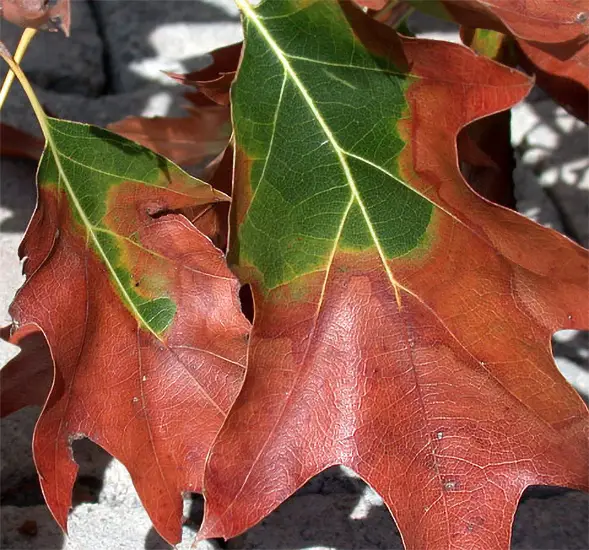
Symptoms of Bacterial Leaf Scorch typically appear in the latter part of summer and into the fall. The most characteristic symptom of BLS is marginal leaf scorch. A yellow band, or “halo”, forms between live green tissue and dead brown tissue. Bacterial Leaf Scorch can be positively identified through laboratory tests.
Treatment
There are no curative controls for Bacterial Leaf Scorch. Antibiotics injected annually can slow the spread of BLS in a tree, but they are not a cure and therefore are not recommended. Limbs affected by BLS should be removed to slow the spread through the canopy.
Management
Managing tree stress is a crucial component of disease management. Trees can remain healthier and aesthetically pleasing longer by properly managing water, avoiding compaction and grade changes, and controlling insect damage. Fertilization improves tree vigor.
Affected Species
- Quercus palustris (Pin Oak)
- Quercus rubra (Red Oak)
- Quercus velutina (Black Oak)
- Ulmus americana (American Elm)